Learn why Bulldog Rack Company delivers complete warehouse solutions.
Every shift change in a traditional shuttle warehouse looks the same: forklift drivers pull shuttles out of the racking, lower them to the ground, and transport them to a maintenance station for charging. It is a choreographed routine that most operations accept as normal.
It is also where most shuttle accidents happen.
Dropped shuttles. Loose wires. Damaged connectors. Forklift collisions. The manual battery swap process is the single biggest source of shuttle damage, downtime, and safety incidents in warehouse automation. And it is completely unnecessary.
The Problem with Manual Shuttle Charging
In a conventional semi-automatic shuttle system, charging a shuttle battery requires:
- Forklift extraction—An operator must drive into the rack lane, position the forks under the shuttle, and carefully lift it out of the racking structure.
- Transport to ground level—The shuttle must be lowered from elevated rack levels, often 20-40 feet in the air, requiring precise forklift control.
- Movement to charging station—The shuttle is transported across the warehouse floor to a dedicated maintenance area.
- Manual connection—Operators plug in charging cables, inspect connections, and monitor the charging process.
- Return trip—After charging, the entire process reverses: transport, elevation, and reinsertion into the rack.
This process typically takes 15-25 minutes per shuttle, happens multiple times per day, and exposes both equipment and personnel to unnecessary risk every single time.
Where the Accidents Happen
The data is clear: the overwhelming majority of shuttle damage occurs during manual handling, not during normal operation. The most common failure points include:
- Dropped shuttles—Forks slip, loads shift, or operators misjudge positioning. A shuttle dropped from rack height is often a total loss.
- Forklift collisions—Maneuvering in tight rack lanes with an awkward load leads to impacts with uprights, beams, and other equipment.
- Connector damage—Repeated plugging and unplugging of charging cables wears connectors, causing intermittent connections, overheating, and electrical failures.
- Loose wiring—Manual handling jostles internal components. Over time, vibration and movement loosen wire connections that were never designed for frequent physical manipulation.
- Operator injuries—Heavy equipment, elevated positions, and electrical connections create a trifecta of safety hazards.
Every one of these failure modes is a direct result of removing the shuttle from the rack for charging. Eliminate the removal, and you eliminate the risk.
4D In-Rack Charging: How It Works
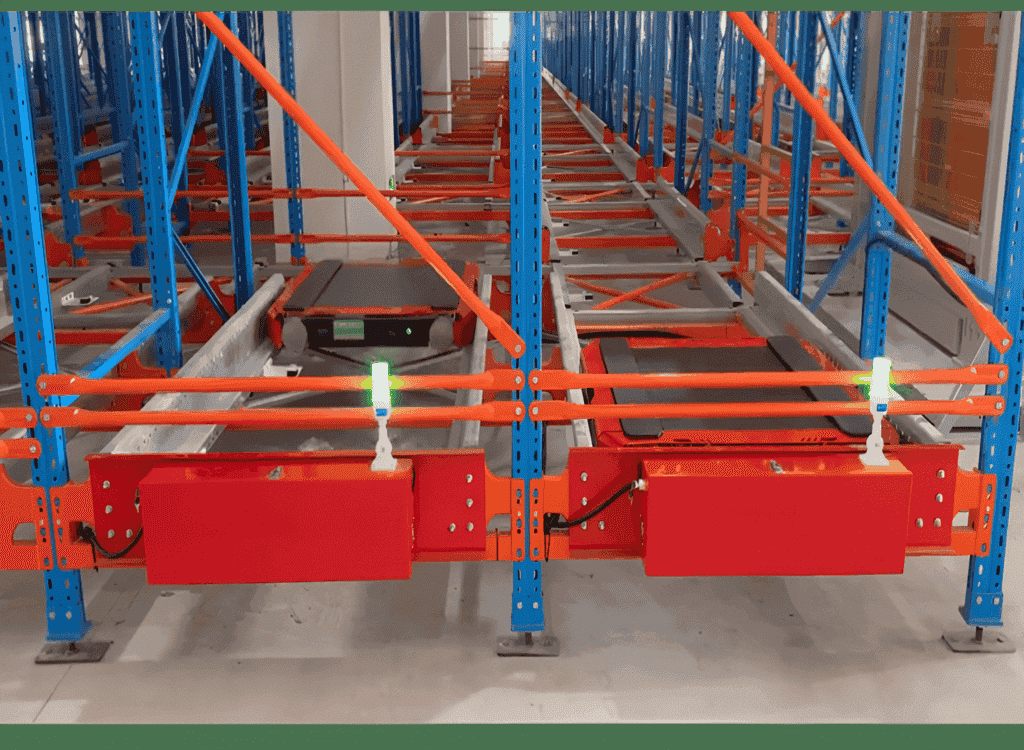
The Bulldog 4D shuttle system takes a fundamentally different approach: the shuttle never leaves the rack.
Autonomous charging stations are integrated directly into the racking structure. When the Battery Management System (BMS) detects that a shuttle's charge level is approaching the threshold, the shuttle automatically navigates to the nearest in-rack charging station—no forklift, no operator, no manual intervention.
The process is simple:
- BMS monitors battery state—Continuous monitoring tracks charge level, temperature, and health metrics for every shuttle in the system.
- Automatic dispatch—When charging is needed, the Warehouse Management System (WMS) routes the shuttle to an available charging station during a natural gap in operations.
- Autonomous docking—The shuttle drives itself onto the charging platform and automatically connects to the charging system.
- Smart charging—The BMS optimizes charging rate based on battery condition, temperature, and operational demand.
- Return to service—Once charged, the shuttle automatically returns to its assigned position and resumes operations.
Total human involvement: zero.
The Numbers That Matter
The 4D shuttle's battery and charging system was designed for continuous warehouse operation:
- 8-10 hours of run time—A fully charged shuttle operates through an entire shift without interruption.
- 2.5 hours of charge time—Fast charging minimizes downtime and maximizes shuttle availability.
- 24/7 operation capability—With proper charging station placement, shuttles can run continuously with no shift-change battery swaps.
- Zero manual handling—No forklift extraction, no transport, no manual connections.
Compare this to manual systems where each shuttle requires 30-50 minutes of total handling time per charge cycle, multiplied across a fleet of 10, 20, or 50 shuttles. The labor savings alone often justify the investment in autonomous charging infrastructure.
They Never Call in Sick
Here is a reality that warehouse managers understand but rarely say out loud: shuttles are more reliable than people.
A 4D shuttle with in-rack charging does not call in sick on the busiest day of the year. It does not complain about working conditions in a 35-degree freezer. It does not need breaks, benefits, or shift differentials. It does not have a bad day that affects productivity, and it does not quit without notice during peak season.
This is not about replacing workers—it is about deploying them where they add value. Every hour a forklift operator spends extracting and charging shuttles is an hour they are not moving product, managing exceptions, or handling the tasks that actually require human judgment. Autonomous charging frees your workforce to do meaningful work instead of babysitting battery levels.
ROI: Beyond Labor Savings
The financial case for in-rack charging extends beyond labor reduction:
- Reduced shuttle damage—Eliminating manual handling eliminates the primary cause of shuttle failures. Fewer repairs, fewer replacements, longer equipment life.
- Lower maintenance costs—No connector wear, no loose wiring, no handling-related component failures.
- Improved uptime—Shuttles spend more time moving pallets and less time being moved themselves.
- Reduced safety incidents—Fewer forklift operations at height means fewer accidents, lower insurance costs, and better OSHA compliance.
- Scalability—Adding shuttles to an in-rack charging system requires no additional labor. The infrastructure scales without proportional headcount increases.
The Bottom Line
Manual shuttle battery changes are a relic of early automation technology—a workaround that made sense when in-rack charging was not technically feasible. That era is over.
The 4D in-rack autonomous charging station represents the current state of the art: shuttles that charge themselves, manage their own battery health, and never require a forklift driver to extract them from the rack. It is safer, faster, more reliable, and more cost-effective than any manual alternative.
If your current shuttle system still requires forklift battery swaps, you are paying for yesterday's technology with today's dollars. The 4D system offers a better way.
Shuttles that charge themselves. Operations that run themselves. That is the 4D difference.